Approach
Writing a novel with AI as a sparring partner
The recent news about the AI race, and the debate about risk and regulation, was the inspiration for a filmscript. I started exploring different storylines and concepts. A few ideas are still left over from that, ones I might use later.
I also explored what it would take to actually make a film. Producing a film would cost a lot of time, so I first thought of a short, but even for that I would need quite a few tools I’d have to subscribe to. So I decided to start with a novel instead, because I could do that with the tools I already had: an AI subscription. Making a film or a short is still an option for later. I had a first concept written, which came out at around 20,000 words. I read that and made some changes to it.
I had it generated into a pdf, and because I started reading it that way, I worked on readability: font size and alignment.
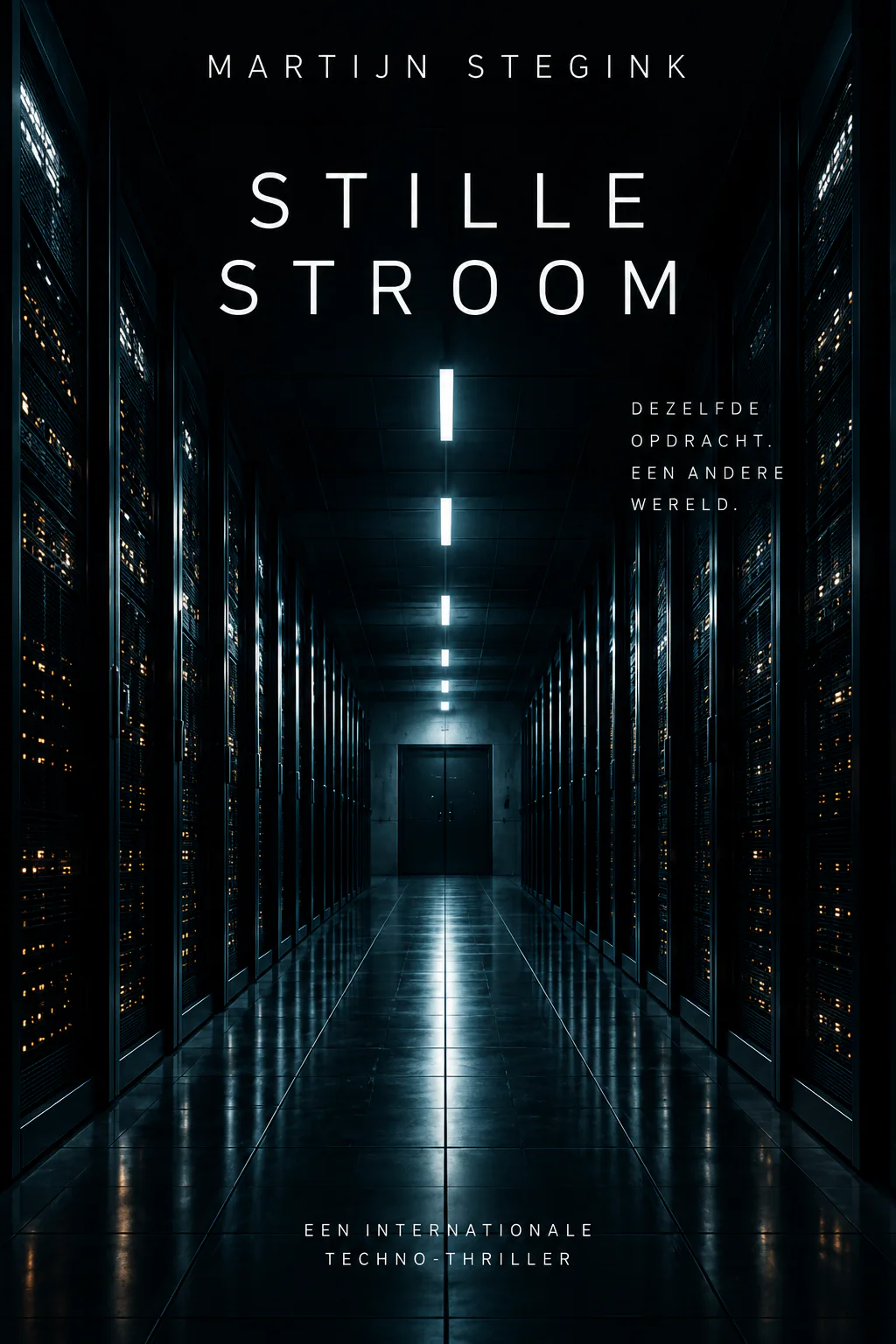
My wife is creative and offered to make a cover. I sent her a summary of the book, and she came back with a number of concepts, from which I picked one. This is the result.
For the further elaboration I first had a style profile written down: long, searching sentences with interiority, multiple points of view close to the characters but not in first person, sparse dialogue, little action pace, more attention to the human and social toll of an event than to chases. That’s a different style than how I communicate myself, at work and in private, but tailored to what suits a novel.
Before giving the instruction to elaborate the book further, I checked how many words a novel normally has: 65,000 to 75,000 words. I then gave the instruction to elaborate the book further. It turned out to be necessary to protect consistency and the storylines: the extra content had to be added in several small rounds instead of one big pass.
Each round turned out to deliberately add only two new paragraphs per chapter, around 2,500 to 3,500 words per round in total across 25 chapters. That’s not a technical limitation, it’s a quality choice: each round has to keep exact track of which kind of addition, dialogue, interiority, sensory detail, flashbacks, was already used in earlier rounds per chapter, to avoid repetition. The more gets added to one chapter in one round, the bigger the risk that the story gets too crowded, the pacing weakens, or it starts repeating itself within that same round.
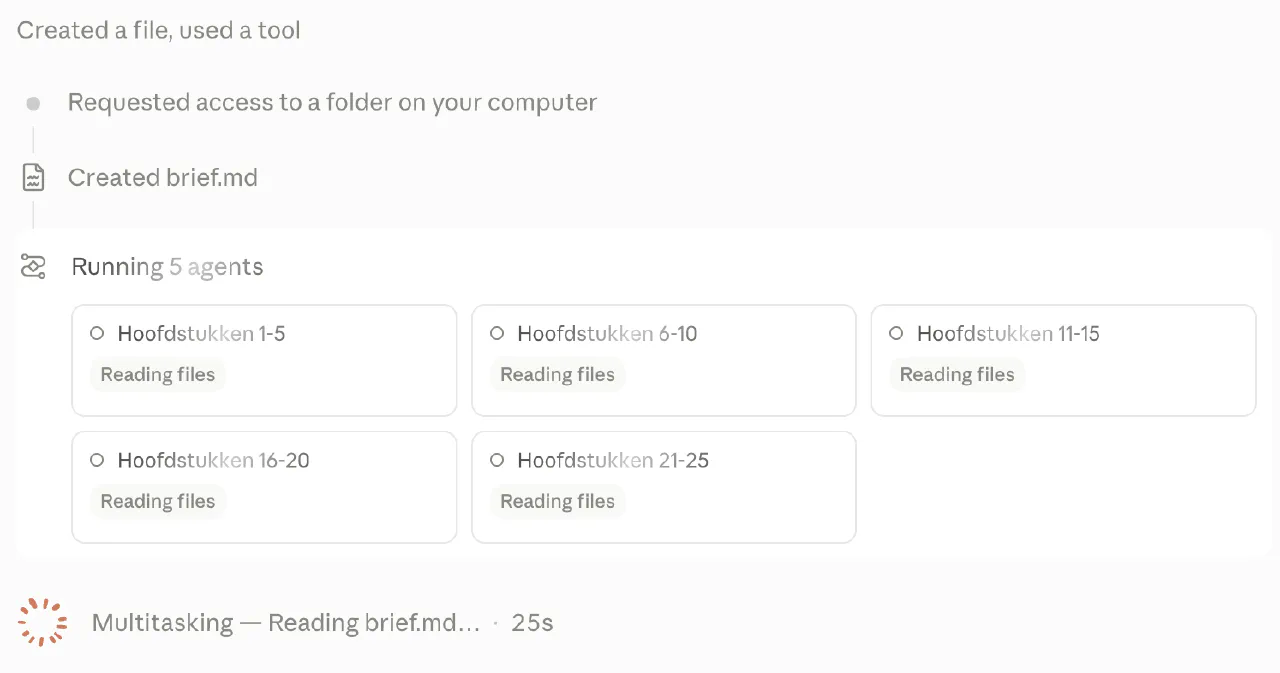
I noticed I was burning through my tokens fast because every round required rereading and reprocessing the entire text. So I decided to split the book into one file per chapter, to cut token use: that way each round only needed to read the relevant chapter instead of the whole book. As an added benefit, this also let several subagents work on the improvements at the same time.
I built out the rest of the book with the remaining components: title page, table of contents, section pages per part, and a copyright page.
Finally, the text about the author. That took a few rounds, because my own instructions to the AI sent it the wrong way a few times: too light for a thriller one time, too pretentious or too philosophical another. In the end I wrote that text myself, and had the AI sharpen it up a bit. Once I was fully satisfied with that, I had an epub made alongside the pdf. That’s needed to make the book properly readable on every device, with a font size that follows whatever the reader sets themselves.
After 6 rounds the count stood at 32,177 words, after 14 rounds at 70,582 words, right in the middle of the 65,000-75,000 words I had in mind. Three parts, 25 chapters, one afterword. Fifteen pdf versions before I called one final, three epub versions after that.
What went wrong: I expected the book to more or less write itself further after the first concept. After the first round I gave the instruction to do another round a few more times, and to my surprise, very little kept getting added each time. Eventually I asked why that was, and that’s when I realized how fast I was burning through my tokens, and decided to split it into separate chapter files. Had I asked that question earlier, I would have saved myself a few rounds of wondering.
On top of that, a few smaller things. The alignment wasn’t right straight away. At one point the section pages went missing. A section number ended up above the title instead of next to it. And the inspiration behind the book kept coming back in a few different places, worded slightly differently, and in one place no longer quite matched reality. The text about the author also took more detours than it needed to, until I just wrote it myself; I could have done that from the start.
Based on my own approach document for Stille Stroom, version 4.